West Chester, Ohio - July 30, 2026 – Structa Wire, a division of ClarkDietrich and a leading manufacturer of welded wire lath, has partnered with DuPont™ to deliver a code-compliant, performance-verified solution for lath-based assemblies applied over continuous insulation, including stucco, stone and thin brick assemblies. The solution combines the proven performance of Structa Wire welded wire lath with the DuPont ArmorWall™ integrated air/water barrier system to help architects and contractors streamline façade specification and installation while supporting modern building envelope performance requirements.
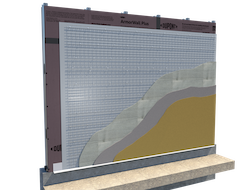
Third-party testing demonstrated that Structa Wire lath can be fastened directly to the ArmorWall panel with fastener pull-out resistance and load carrying capacity equal to or greater than that found in prescriptive ASTM C-1063 guidelines, or standard fasteners anchored into framing. With this assembly, there is no need to extend fasteners into stud framing as in traditional lath fastening methods.
“This collaboration highlights the value of bringing together complementary technologies to create practical solutions for the building industry," said Jan Finseth, sales and marketing manager at ClarkDietrich. “By combining Structa Wire with the DuPont ArmorWall System, architects and contractors gain a tested assembly that can simplify installation while delivering the performance expected in today's exterior wall systems.”
The combined assembly provides a flat surface allowing for uniform plaster thickness, minimizing voids and weak areas. Structa Wire’s continuous roll format and welded wire geometry helps reduce overlaps and helps enhance full plaster embedment.
The ArmorWall™ System is tested to exceed ASTM E331 at 15psf (water penetration resistance) and E283 (air) performance requirements after structural loading (ASTM E2357) and thermal cycling (AAMA 501.5). It helps provide exceptional thermal performance via a continuous insulation design with minimal thermal loss. Clear field thermal analysis demonstrated up to 93% retention of its thermal resistance, well above typical assemblies, when the impact of structural attachment is included.
To learn more about the benefits of the assembly, visit clarkdietrich.com.